
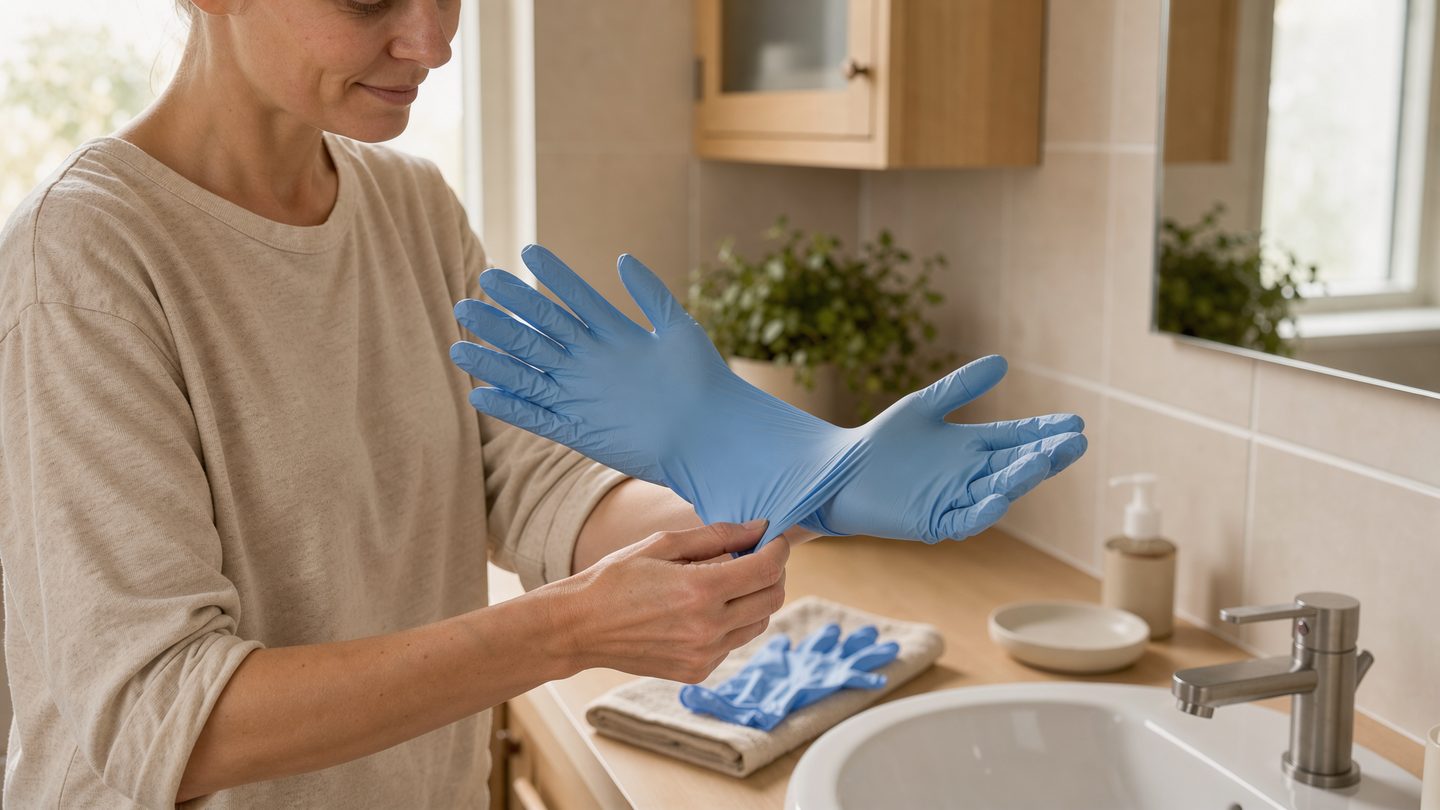
For care tasks that may involve contact with excretions, blood or secretions, you need suitable disposable gloves. They are available in latex, nitrile or vinyl. How the materials differ, what to look out for if you have a latex allergy and how to wear gloves correctly.
Key points
- Natural latex (Naturlatex) can trigger allergies, usually of the immediate type. Powdered latex gloves are particularly unfavourable, because the allergens stick to the powder and get into the air.
- Nitrile and vinyl are latex-free. Nitrile is considered hard-wearing and allows a good sense of touch; allergies to vinyl are very rare.
- Even latex-free rubber gloves, for example made of nitrile, can trigger a contact allergy because of certain additives.
- Thin disposable gloves are often not designed for handling disinfectants and cleaning agents.
- Disinfect your hands after taking the gloves off – gloves can have tiny holes.
The materials compared
| Material | Properties according to the BGW | Points to note |
|---|---|---|
| Natural latex | – | Latex proteins can trigger allergies; use only powder-free gloves |
| Nitrile | latex-free, fine sense of touch, good mechanical resistance, low risk of allergy | Additives from the manufacturing process can, in rare cases, trigger contact allergies |
| Vinyl | latex-free, protects against water, soap and creams, allergies very rare | – |
The information comes from the German Social Accident Insurance Institution for the Health and Welfare Services (Berufsgenossenschaft für Gesundheitsdienst und Wohlfahrtspflege, BGW). In professional care, powdered latex gloves are not permitted under the Technical Rules for Hazardous Substances (Technische Regeln für Gefahrstoffe, TRGS 401); for care at home, this is a sensible guide.
Medical glove or protective glove?
Medical disposable gloves under the standard DIN EN 455 mainly protect the person being cared for. Protective gloves under EN ISO 374 protect the wearer, including against chemicals. For care, the Commission for Hospital Hygiene and Infection Prevention (KRINKO) at the Robert Koch Institute recommends gloves that are one or the other. According to the BGW, anyone working with harsh cleaning agents or disinfectants needs resistant protective gloves, ideally with a long cuff.
How to wear gloves correctly
- In the right size, and only on clean, dry hands.
- Only for as long as necessary, and use them only once.
- Change them if they become damp inside; if you wear them for longer, cotton undergloves help.
- Disinfect your hands after taking the gloves off – more on this in the article Hand or surface disinfection.
Frequently asked questions
What should I do if I have a latex allergy?
Avoid latex, including in the household, and carry an allergy passport (Allergiepass) with you. Latex is also found in some finger cots, plasters or sheath catheters (Kondomurinale). Sheath catheters are available latex-free, see Sheath catheter. Inform the treatment team before a stay in hospital.
How do I protect my skin if I wear gloves often?
When changing gloves, dry your hands rather than washing them, and apply cream after the task. Do not apply skin care cream immediately before putting gloves on.
Can I get disposable gloves from the long-term care insurance?
Yes, if you have a care level (Pflegegrad) and care takes place at home. Disposable gloves are among the consumable care aids (Pflegehilfsmittel zum Verbrauch) for which the long-term care insurance (Pflegekasse) currently pays up to 42 euros a month. The draft bill for the Care Reorganisation Act (Pflegeneuordnungsgesetz, printed paper 21/8869) provides that this separate entitlement would end on 1 January 2027; in its opinion of 20 November 2026, the Bundesrat asks for an examination of how it can in principle be retained as an earmarked benefit in kind (Sachleistung) (printed paper 587/26 (Beschluss), item 17). Nothing has been decided yet – until the law is changed, the 42-euro rule applies; more in the article on the care aids package.
How PharmaCare helps
You can get disposable gloves from us in the monthly care aids package – the long-term care insurance currently pays up to 42 euros a month, also for people with private insurance. You will find the application forms among our downloads (in German).
0800 74 222 73WhatsAppSignalSources
- Latex allergies and prevention, Glove gallery, How to protect your skin and Protective gloves, German Social Accident Insurance Institution for the Health and Welfare Services (BGW) (in German)
- TRGS 401 Hazards from skin contact, version of 19 September 2024 (section 5.5.1, Annex 3) (in German)
- TRBA 250 Biological agents in healthcare and welfare services, edition of November 2025 (section 4.2.8) (in German)
- Hand hygiene in healthcare facilities, KRINKO at the Robert Koch Institute, 2016 (in German)
- Latex allergy, German Allergy and Asthma Association (Deutscher Allergie- und Asthmabund) (in German)
- List of care aids, product group 54, National Association of Statutory Health Insurance Funds, 19 March 2025 (54.99.01.1) (in German)
- Printed paper 21/8869, government draft bill on the Care Reorganisation Act, German Bundestag (in German)
- Opinion of the Bundesrat on the draft Care Reorganisation Act, printed paper 587/26 (Beschluss) of 20 November 2026, Bundesrat (in German) – item 17
Note: This article gives a general overview and does not replace medical advice or legal advice. Your health insurance fund or long-term care insurance decides on your entitlement. The text was written with the help of artificial intelligence; all information has been checked against the sources listed. As of: 21 November 2026.