
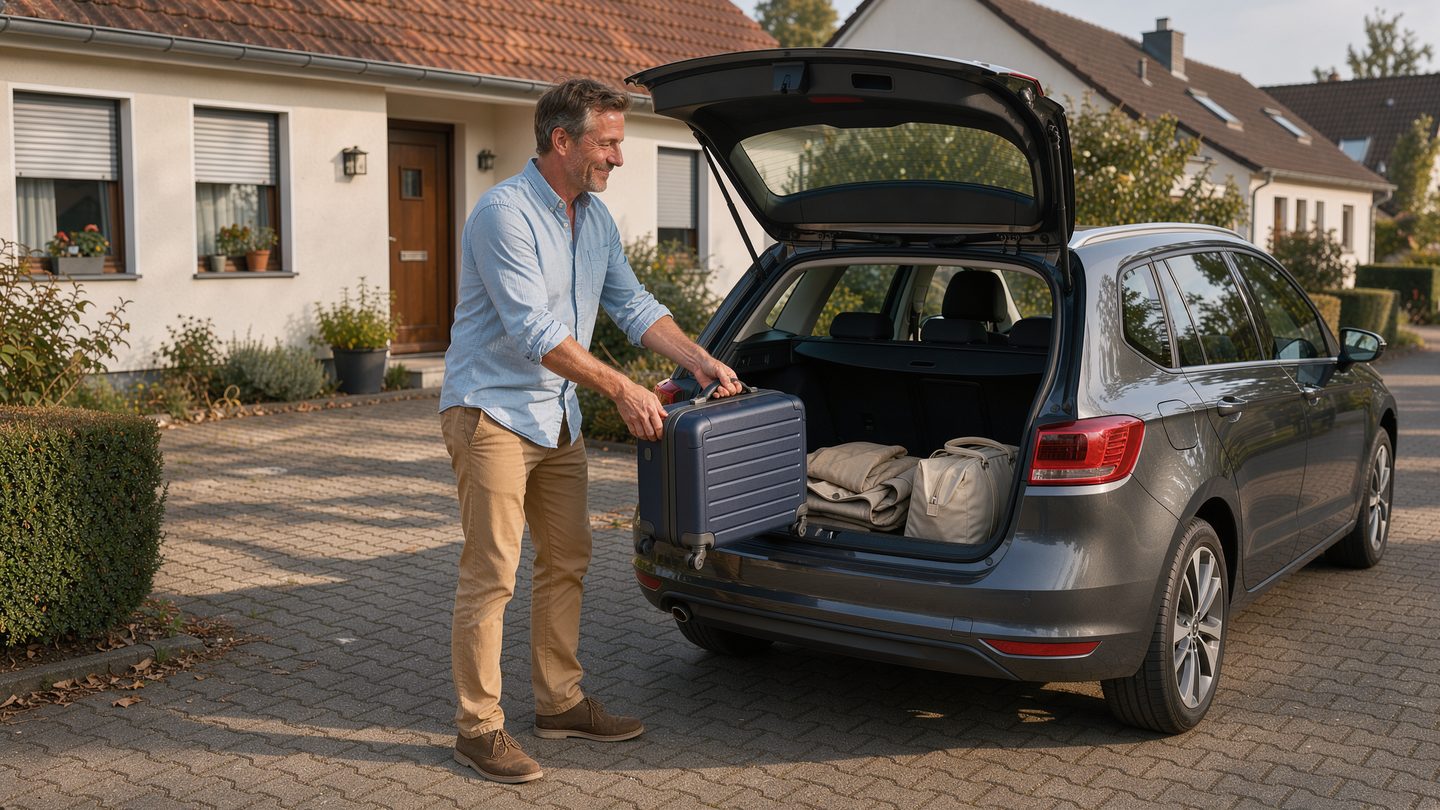
A catheter is no reason to give up travelling. With a little planning, you can get through airport security and your holiday without stress. The key points for catheterising while you are away and for indwelling catheters.
Key points
- Pack an emergency supply in your hand luggage – the German Continence Society (Deutsche Kontinenz Gesellschaft) advises taking medical aids for at least three days in case your suitcase gets lost.
- A doctor’s certificate (ärztliches Attest) stating that you need medical aids makes conversations at the security check easier. The Medical Travel Certificate of the EAUN is available free of charge for you to fill in with your doctor’s practice.
- In the EU, quantity limits apply to liquids in hand luggage. If in doubt, the security staff decide whether prefilled catheters fall under these limits.
- With the Euro key (Euroschlüssel), you can open many accessible toilets for disabled people in Germany and some neighbouring countries.
- Drink enough while travelling too, and all the more so in hot weather.
What to pack in your hand luggage
- Catheters and accessories for at least three days, the rest in your suitcase
- A certificate of your needs, ideally in several languages, such as the Medical Travel Certificate of the European Association of Urology Nurses, which has an explanatory text in several languages
- Hand disinfectant in travel size – according to the guideline, this lets you prepare your hands even without a washbasin
- Wet wipes, disposable toilet seat covers, spare clothes and bags for disposal
The guideline on intermittent catheterisation (intermittierender Katheterismus) recommends also basing the choice of catheter on whether you catheterise at home or while you are out and about. For travelling, there are compact catheters and models with an integrated bag. Whether such a catheter is right for you is something to clarify with your doctor or your nurse before you travel.
At the security check
According to the information from the German Federal Police (Bundespolizei), liquids may be carried in hand luggage in containers of up to 100 millilitres in a transparent, resealable one-litre bag. There is an exception for medicines that you need during the journey if you can credibly show that you need them, for example with a prescription or a doctor’s certificate. Catheters filled with water or gel are medical devices, not medicines – so take your certificate with you and show the catheters without being asked. At some airports, larger quantities are now permitted thanks to new scanners; outside the EU, the rules may differ.
Frequently asked questions
Who can get a Euro key?
It is issued by the Club Behinderter und ihrer Freunde (CBF) Darmstadt. Those eligible include people whose severely disabled person’s pass (Schwerbehindertenausweis) shows the marking (Merkzeichen) aG, B, H or BL, people with the marking G and a degree of disability (Grad der Behinderung) of at least 70, and people with a degree of disability of 80 or more. Without a suitable pass, a doctor’s certificate showing that you depend on an accessible toilet may be enough.
I have an indwelling catheter – what should I look out for?
The same as at home: keep the system closed as far as possible, wear the bag below bladder level without it touching the floor and empty it in good time. More in the article Leg bag or bed bag.
What if I get an infection while I am away?
Watch out for burning, fever or pain in your side (flank pain); cloudy urine alone is not a reliable sign. Before you travel, discuss with your doctor’s practice what to do if it happens. More in the article Urinary tract infections when catheterising.
How PharmaCare helps
We advise you independently of any manufacturer, including on your supplies for when you are away, and deliver your prescribed supplies discreetly to your home. Get in touch with us in good time if you are planning a trip. More under Catheters and urine drainage.
0800 74 222 73WhatsAppSignalSources
- Liquids on board, Federal Police, November 2025 (in German)
- The joy of travelling – even with incontinence, German Continence Society, July 2024 (in German)
- Medical Travel Certificate, European Association of Urology Nurses, provided by the Manfred Sauer Foundation (der-querschnitt.de) (in English, with an explanatory text in several languages)
- S2k guideline “Management and performance of intermittent catheterisation”, AWMF register 043-048, version 3.0, February 2026 (in German)
- Prevention and control of catheter-associated urinary tract infections, Commission for Hospital Hygiene and Infection Prevention (KRINKO) at the Robert Koch Institute, 2015 (in German)
- Euro key, CBF Darmstadt (in German)
- Heat and health, gesund.bund.de (in German)
Note: This article gives a general overview and does not replace medical advice or legal advice. Rules at airports can change at short notice; check with the airport or the airline before you travel. Your health insurance fund or long-term care insurance decides on your entitlement. The text was written with the help of artificial intelligence; all information has been checked against the sources listed. As of: 31 October 2026.