If you have incontinence, you can get pads, pants, intermittent catheters or urine bags on prescription. This guide explains what your entitlement is based on, what you pay yourself and what to look out for on the prescription.
In Germany, most people are insured with a statutory health insurance fund (Krankenkasse), which pays for medically necessary treatment and medical aids (Hilfsmittel).
Key points
- Incontinence products are medical aids paid for by the health insurance fund under § 33 SGB V (Social Code Book V). The fund pays for them if they are medically necessary in your individual case – you do not need a care level (Pflegegrad) for this.
- From the age of 18, you pay a co-payment (Zuzahlung) of 10 per cent. For consumable products such as pads or catheters, this is no more than 10 euros a month until the end of 2026, and no more than 15 euros from 1 January 2027.
- Submit your prescription soon: if supply does not begin within 28 days of the date it was issued, and the fund has not received an application by then either, the prescription becomes invalid.
- You decide for yourself which of your health insurance fund’s contracted suppliers delivers your products.
- The fund must decide on an application within three weeks at the latest, or within five weeks if it obtains an expert opinion.
What your entitlement is based on
The legal basis is § 33(1) SGB V:
“Insured persons are entitled to be supplied with hearing aids, prostheses, orthopaedic and other medical aids that are necessary in the individual case to secure the success of medical treatment, to prevent an impending disability or to compensate for a disability …”
§ 33(1), sentence 1 SGB V (our translation)
With incontinence, the medical aid compensates for a restricted bodily function. The only exceptions are general everyday items. Which products are included is set out in the list of medical aids (Hilfsmittelverzeichnis) of the National Association of Statutory Health Insurance Funds (GKV-Spitzenverband), in product group 15 “Incontinence aids”: absorbent aids such as pads, adult nappies and pants, as well as drainage aids such as intermittent catheters, urinary sheaths and urine bags. They must at least meet the quality requirements laid down there (§ 33(1), sentence 2 SGB V).
Your doctor can prescribe what is medically indicated and helps you to meet the basic needs of everyday life and take part in life. The quantity depends not only on the amount of urine, but also on hygiene and your care situation. Depending on the individual case, five or more products in 24 hours may be needed.
What the prescription should say
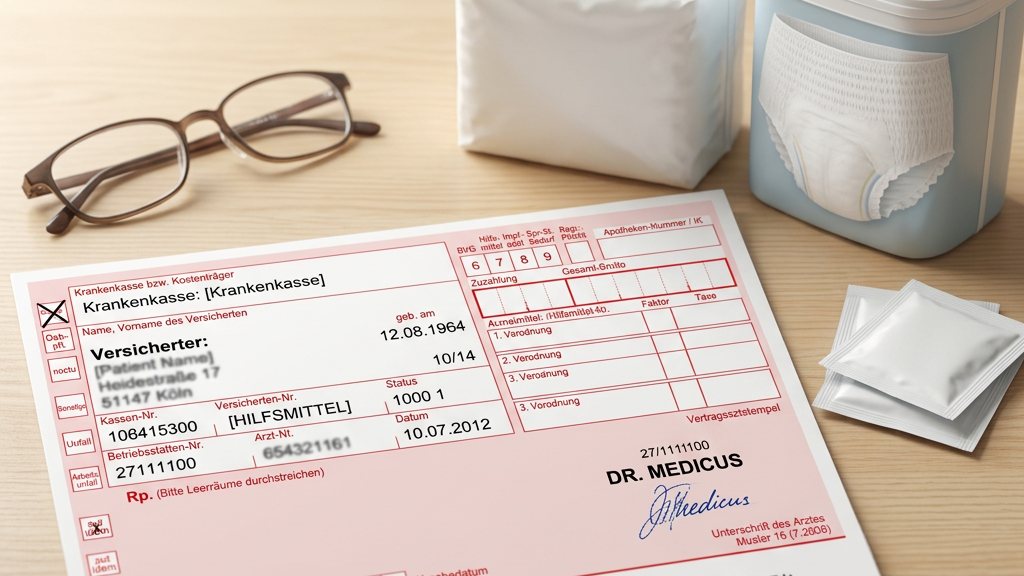
What a prescription (Rezept, form Muster 16) must contain is governed by the Medical Aids Directive (Hilfsmittel-Richtlinie) of the Federal Joint Committee (Gemeinsamer Bundesausschuss): besides the diagnosis and date, above all the medical aid – as a product type according to the list of medical aids or with the seven-digit item number – the quantity and, if needed, notes on size or material, for example. The supplier usually chooses the specific product together with you, within the contracts of your fund. If your doctor considers a particular product necessary, they can prescribe it and give their reasons.
Keep an eye on the deadline: if supply does not begin within 28 calendar days of the date of issue, the prescription is no longer valid – unless the application reached the health insurance fund within this period.
Sometimes it works without a doctor’s prescription: if the assessor recommends absorbent incontinence aids during the assessment for a care level, this counts as an application, provided you agree (§ 18b(3) SGB XI). Nurses can also recommend certain medical aids, such as absorbent incontinence aids (§ 40(6) SGB XI). What this means and why they are not yet allowed to prescribe themselves is explained in the article Prescriptions by nurses (in German).
What you pay yourself
Children and young people do not pay anything. From your 18th birthday, the co-payment is 10 per cent, with upper limits depending on the type of medical aid:
- Consumable medical aids such as pads, pants, intermittent catheters or urine bags: 10 per cent of the amount the fund pays, no more than 10 euros for your entire monthly supply – no matter how many packs you receive. From 1 January 2027, the limit is 15 euros.
- Other medical aids that you use for longer: 10 per cent, at least 5 and no more than 10 euros per medical aid, from 2027 at least 7.50 and no more than 15 euros – but never more than the medical aid costs.
Why the law has already stated 15 euros for consumable products since 30 July 2026, while 10 euros applies until the end of the year, is explained in the article Co-payment from 2027.
The annual cap limits your co-payments for the year
All co-payments of a household together are capped (Belastungsgrenze): in a calendar year, they must not exceed 2 per cent of the household’s annual gross income for living costs. For people in long-term treatment for the same serious chronic illness, the limit is 1 per cent (§ 62 SGB V). Your fund will not contact you of its own accord when you reach the limit. So keep your receipts and apply to your health insurance fund for an exemption – you can also do this afterwards, and anything you have overpaid will then be refunded.
Extra costs (Mehrkosten) are not the same as the co-payment: they only arise if you yourself choose a product that goes beyond what is necessary. Before that, the supplier must advise you on which supply is suitable and necessary for you, and have you sign to confirm this (§ 127(5) SGB V). More on this in the article Paying extra for medical aids (in German).
You decide who supplies you
You decide which medical supply store or homecare provider delivers to you:
“Insured persons may use all service providers who are contracted partners of their health insurance fund.”
§ 33(6), sentence 1 SGB V (our translation)
Doctors’ practices and health insurance funds must not assign prescriptions to a particular provider or steer you towards one – unless a law provides for this or there are medical reasons for it in the individual case. This expressly also applies to electronic prescriptions. Your fund must tell you which providers are contracted partners (§ 127(6) SGB V).
How long the fund has to decide
If your fund requires approval, under § 13(3a) SGB V it must decide no later than three weeks after receiving the application, or within five weeks if it obtains an expert opinion, for example from the Medical Service (Medizinischer Dienst). If it cannot manage this, it must inform you in good time and give its reasons.
If it does not inform you, the benefit is deemed approved once the deadline has passed. However, according to a 2020 ruling of the Federal Social Court (Bundessozialgericht), this does not create a separate right to delivery, but the right to obtain the medical aid yourself and claim reimbursement of the costs. Get advice before you pay in advance.
Frequently asked questions
Do I need a care level to get incontinence products?
No. Incontinence products are medical aids paid for by the health insurance fund; a care level plays no role here. If you have a care level and are cared for at home, you may also be entitled to care aids (Pflegehilfsmittel) from the long-term care insurance (Pflegekasse), such as disposable gloves or absorbent bed protectors. The difference is explained in the article Health insurance or long-term care insurance.
What can I do if the prescribed quantity is not enough?
Talk to your doctor about adjusting the prescription. The quantity should match your actual needs; besides the amount of urine, this also includes hygiene and your care situation. Paying extra is not the right way to deal with this.
Can children also get incontinence products on prescription?
Yes, and they do not pay a co-payment. There is an age limit for absorbent products: up to the age of three, nappies are normal for a child’s age, so the health insurance fund generally does not pay for absorbent incontinence aids during this time.
What can I do if the fund refuses?
You can lodge an objection (Widerspruch) within one month of being notified of the decision – in writing, electronically or by having it recorded at the fund (§ 84 of the Social Courts Act, Sozialgerichtsgesetz). Ideally, enclose a statement from your doctor explaining why you need exactly this supply. How to go about it is shown in the article Objecting to a health insurance decision (in German).
How PharmaCare helps
Send us your original prescription to PharmaCare GmbH, Raiffeisenallee 16, 82041 Oberhaching – the easiest way is with our free envelope (forms and free envelope (in German)). You can send us a photo of the prescription in advance via WhatsApp or Signal.
We arrange approval with your health insurance fund, advise you on suitable products, deliver discreetly to your home and bill your fund directly. You can reach our medical specialists free of charge, Monday to Friday from 8 am to 5 pm.
0800 74 222 73WhatsAppSignalSources
- SGB V: § 13 – Reimbursement of costs, decision deadlines, § 33 – Medical aids, § 61 – Co-payments, § 62 – Annual cap, § 127 – Contracts, duty to advise, Federal Ministry of Justice (in German)
- § 18b SGB XI – Recommendations in the care assessment and § 84 Social Courts Act – Deadline for objections, Federal Ministry of Justice (in German)
- Medical Aids Directive (§§ 7 and 8), Federal Joint Committee, in force since 16 May 2025 (in German)
- List of medical aids, product group 15 “Incontinence aids”, National Association of Statutory Health Insurance Funds, published on 30 January 2025 (in German)
- Annual cap (Belastungsgrenze), Federal Ministry of Health (in German)
- Ruling of 26 May 2020, B 1 KR 9/18 R (deemed approval), Federal Social Court (in German)
Note: This article gives a general overview and does not replace medical or legal advice. Your health insurance fund or long-term care insurance decides on your entitlement. The text was written with the help of artificial intelligence; all information has been checked against the sources listed. As of: 24 September 2026.