
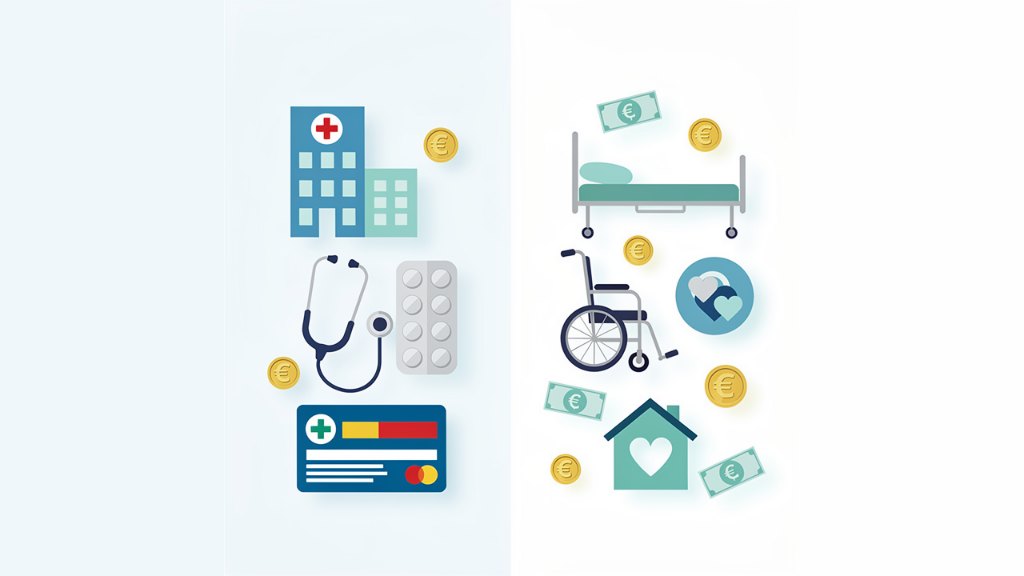
Two payers with their own rules may cover medical aids: the statutory health insurance fund (Krankenkasse) and the long-term care insurance (Pflegekasse). Here you can see which one is responsible for what, what you need in each case and what you pay yourself.
In Germany, these are two separate branches of social insurance: health insurance covers illness and disability, long-term care insurance covers the need for care.
Key points
- The health insurance fund pays for medical aids (Hilfsmittel) that are needed because of illness or disability, such as incontinence products, catheters or ostomy supplies – usually with a prescription (Rezept), without a care level (Pflegegrad).
- The long-term care insurance pays for care aids (Pflegehilfsmittel) that make care at home easier. You need a care level, but no prescription; care level 1 is already enough.
- For consumable products such as disposable gloves or bed protectors, the long-term care insurance covers up to 42 euros a month, with no co-payment.
- If you are entitled to something from the health insurance fund, that takes priority. Pads and pants are therefore supplied on prescription, even if you have a care level.
- Both entitlements can exist side by side. For products that serve both purposes, the fund you apply to checks who is responsible.
Health insurance: medical aids because of illness or disability
Your entitlement from the health insurance fund is set out in § 33 SGB V (Social Code Book V). A medical aid must be necessary in the individual case to secure treatment, to prevent a disability or to compensate for it. You do not need a care level for this, but you usually do need a doctor’s prescription. Typical examples are incontinence products, intermittent catheters and urine bags, ostomy supplies, orthoses, walking aids and wheelchairs.
From the age of 18, you pay a co-payment (Zuzahlung) of 10 per cent, for consumable products no more than 10 euros a month; from 2027, the limits rise (see table below). How supply on prescription works is described in the article Incontinence products on prescription.
Long-term care insurance: care aids for care at home
Your entitlement from the long-term care insurance is based on § 40 SGB XI:
“People in need of care are entitled to be supplied with care aids that help to make care easier or to relieve the complaints of the person in need of care, or that enable them to lead a more independent life, insofar as the aids are not to be provided by the health insurance or other responsible agencies because of illness or disability.”
§ 40(1), sentence 1 SGB XI (our translation)
What counts here is the need for care: you need a recognised care level between 1 and 5 and must be cared for at home. You apply to the long-term care insurance. If the assessor recommends certain care aids during the care assessment, this already counts as an application, provided you agree. There are two types.
Consumable care aids
According to the list of care aids (Pflegehilfsmittelverzeichnis), these include disposable absorbent bed protectors, disposable gloves, finger cots, protective aprons, medical face masks and FFP2 masks, as well as disinfectants for hands and surfaces. The long-term care insurance covers up to 42 euros a month for these (§ 40(2) SGB XI), with no co-payment.
Technical care aids
These include, for example, care beds, positioning aids or a home emergency call system. Where possible, the long-term care insurance should provide them on loan. Adults pay a co-payment of 10 per cent for technical care aids, no more than 25 euros per aid; according to the joint circular of the long-term care insurance funds, there is no co-payment for loaned aids. If you turn down an offered loan without a compelling reason, you bear the full costs yourself.
Who pays if both could be responsible?
The answer lies in the last part of the sentence quoted above: the long-term care insurance is only responsible insofar as the health insurance fund does not have to provide the aid because of illness or disability. That is why the first step is always to check whether there is an entitlement under § 33 SGB V.
This explains a distinction that often causes confusion: pads and pants are worn on the body and are incontinence aids from the health insurance fund. Disposable absorbent bed protectors, on the other hand, are in the list of care aids and can be obtained through the monthly 42 euros.
For products that can serve both purposes, § 40(5) SGB XI provides that the fund you apply to checks which fund is responsible and decides; the co-payment then follows the rules of the health insurance. So a prescription and an application for care aids do not rule each other out.
Both routes at a glance
| Feature | Health insurance fund | Long-term care insurance |
|---|---|---|
| Law | § 33 SGB V | § 40 SGB XI |
| Requirement | Illness or disability | Care level 1 to 5, care at home |
| Prescription | usually yes | no, application to the long-term care insurance |
| Co-payment from age 18 | 10 per cent; consumable products no more than 10 euros a month (from 2027: 15 euros), otherwise 5 to 10 euros per medical aid (from 2027: 7.50 to 15 euros) | Consumable products: none; technical: 10 per cent, no more than 25 euros, none for loans |
| Upper limit | no fixed monthly amount | 42 euros a month for consumable products |
| Examples | Pads, pants, catheters, ostomy supplies, wheelchair | Disposable gloves, bed protectors, disinfectants, care bed |
What could change
On 30 September 2026, the Federal Cabinet adopted the government bill (Gesetzentwurf der Bundesregierung) of a Care Reorganisation Act (Pflegeneuordnungsgesetz). Under this bill, the separate entitlement to consumable care aids would end on 1 January 2027; the products would then be paid for from the care allowance (Pflegegeld), which would be based on a new relief budget. The Bundestag and Bundesrat have not yet decided. Until further notice, the 42 euros a month remain unchanged. The progress of the reform is followed in the article Future Pact for Care (in German).
Frequently asked questions
Do I need a prescription for care aids?
No. You submit an application to your long-term care insurance. The requirements are a recognised care level and care at home. How to get a care level is explained in the article Applying for a care level.
Can I have the 42 euros paid out to me?
No. The long-term care insurance covers the costs of consumable care aids up to this amount – as a benefit in kind through a contracted supplier or as reimbursement of your documented expenses. Amounts you do not use are not paid out. More on this in the article Care package: what you are entitled to (in German).
Does my exemption from co-payments also apply to the long-term care insurance?
Yes. If you have reached your annual cap (Belastungsgrenze) with the health insurance fund, the co-payments for technical care aids no longer apply either (§ 40(3) SGB XI). The exemption certificate takes this into account.
Can I choose the supplier freely?
Yes, with both funds. § 40(1) SGB XI refers to the freedom of choice under § 33(6) SGB V: you can use any contracted supplier of your fund.
Do people with private insurance also get care aids?
For care, yes: private compulsory long-term care insurance must provide equivalent benefits and, instead of a benefit in kind, reimburses the costs in the same amount (§ 23 SGB XI).
How PharmaCare helps
For medical aids on prescription, send us your prescription – we arrange approval with your health insurance fund, deliver discreetly to your home and bill the fund directly. For care at home, we supply monthly packages of care aids; the long-term care insurance pays up to 42 euros a month. You will find the application forms under forms and free envelope (in German), including for people with private insurance.
Our medical specialists answer your questions free of charge, Monday to Friday from 8 am to 5 pm.
0800 74 222 73WhatsAppSignalSources
- § 33 SGB V – Medical aids, Federal Ministry of Justice (in German)
- SGB XI: § 18b – Recommendations in the care assessment, § 23 – Private compulsory long-term care insurance, § 28a – Benefits with care level 1, § 40 – Care aids, Federal Ministry of Justice (in German)
- Care aids, Federal Ministry of Health, as of 14 September 2026 (in German)
- Joint circular on the benefit provisions of SGB XI (on § 40), National Association of Statutory Health Insurance Funds and the associations of the long-term care insurance funds, 2 April 2026 (in German)
- List of medical aids: Product group 54 “Consumable care aids” and Product group 15 “Incontinence aids”, National Association of Statutory Health Insurance Funds (in German)
- Care Reorganisation Act (PNOG), government bill of 30 September 2026 and progress of the procedure, Federal Ministry of Health (in German)
Note: This article gives a general overview and does not replace medical or legal advice. Your health insurance fund or long-term care insurance decides on your entitlement. The text was written with the help of artificial intelligence; all information has been checked against the sources listed. As of: 1 October 2026.