
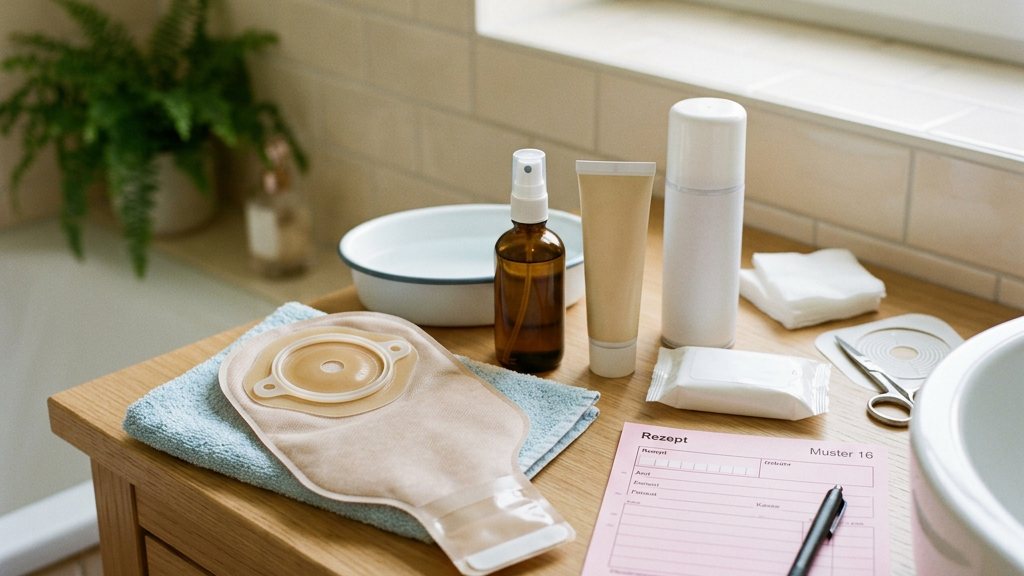
The skin around the stoma carries the ostomy appliance and at the same time has to withstand stool or urine. Here you can read how to care for it when you change your appliance, which products harm it and when a skin change should be looked at by a professional.
Key points
- Skin problems are among the most common complications after a stoma has been created. In an analysis by Erlangen University Hospital, 40 per cent of the people with a stoma who were examined had skin changes.
- The most common is damage caused by moisture, for example when stool or urine gets under the baseplate. That is why the opening in the baseplate must fit the stoma exactly, and a leaking appliance should be changed soon.
- Water is enough for cleansing, if needed with a pH-neutral wash lotion without added oils (nicht rückfettend). Disinfectants, greasy ointments and paper tissues do not belong on the skin around the stoma.
- Skin protection rings, pastes, powders and barrier films can seal and protect the skin. It is best to clarify which product suits you with your stoma therapist (Stomatherapie).
- You should have open, weeping or painful areas and ulcers checked by a professional.
How common are skin problems?
A review published in 2022 describes skin complications as the most common complications after stoma surgery. How often they occur depends on how and when they are counted: in the studies analysed, 36.3 to 73.4 per cent of patients developed skin problems after the operation.
An analysis by Erlangen University Hospital published in 2024 covered 565 people with a stoma who had been seen in the surgical department or the dermatology clinic. 227 of them (40.2 per cent) had skin changes – most commonly damage caused by moisture (27.9 per cent), followed by ulcers (21.9 per cent) and eczema-like changes (19.1 per cent). Because the figures come from a hospital, they do not necessarily apply to all people with a stoma.
Why output harms the skin
Stool from the small intestine still contains a lot of digestive juices and is very harsh on the skin; with a urostomy (Urostoma), urine flows constantly. If output gets under the baseplate or onto uncovered skin, the skin can become irritated. Allergic reactions to the material are also possible.
The most important protection is therefore an opening that fits: the baseplate (Basisplatte) surrounds the stoma without constricting it and leaves no skin uncovered. The German Society for Stoma, Continence and Wound Care (Fachgesellschaft Stoma, Kontinenz und Wunde, FgSKW) provides for checking the size of the stoma at every change and adjusting the opening if necessary. How to go about this step by step is explained in the article Measuring your stoma and cutting the baseplate. The shape of your abdomen can also change, for example due to a hernia next to the stoma. If the appliance leaks, change it soon: liquid stool in particular is harsh on the skin, stresses Deutsche ILCO, the self-help association for people with a stoma.
How to cleanse the skin when changing
The FgSKW guideline describes this procedure:
- Get everything ready: the new appliance, cut to fit, water, non-sterile gauze or non-woven swabs (Kompressen), a waste bag and, if needed, wash lotion, skin protection and a disposable razor.
- Carefully remove the old appliance from top to bottom. If it sticks very firmly, an adhesive remover helps.
- Cleanse the stoma and the skin with moistened swabs from the outside inwards. With a urostomy, clean the skin and the mucous membrane with separate swabs or wipe from the inside outwards.
- Look at the skin and the stoma and check the size.
- Remove hair with a disposable razor if necessary.
- Pat the skin dry with dry swabs.
- Apply a barrier film if needed, then attach the new appliance.
Afterwards, place your hand on the appliance for a few minutes – the warmth helps the skin protection to mould itself to the skin, advises ILCO. If you have used a care product that could interfere with adhesion, wipe the skin again with clear water.
What does not belong on the skin around the stoma?
The guideline lists products that are unsuitable for stoma care – including many household items:
- disinfectants
- perfumed soap with added oils
- greasy products such as ointments, care foam and care wipes
- petrol, ether, acetone and alcohol
- cellulose tissue, such as toilet paper, kitchen roll or paper handkerchiefs
- flannels and sponges that are used more than once
- razor blades, cut-throat razors, electric shavers and hair removal creams
- adhesives and plasters containing zinc oxide
Oily and greasy products can also impair the adhesion of the baseplate. If you want to care for your skin, use creams or lotions that have been developed specifically for ostomy care and are not greasy. According to the guideline, products such as adhesive removers, gelling materials and disposable flannels are only suitable to a limited extent – the flannels provided they are not used for days.
Medical aids for skin protection
If the baseplate alone is not enough, additional products can help. The list of medical aids (Hilfsmittelverzeichnis) describes their purpose as follows:
| Medical aid | What it is intended for |
|---|---|
| Skin protection ring | shields the skin directly next to the stoma, seals against liquid output and evens out folds or scars; inflamed areas can heal underneath it |
| Skin protection paste | is applied in the area of the adhesive surface, spreads under pressure and seals between the skin and the pouch |
| Skin protection powder | seals small irregularities, protects sensitive skin and is used in the after-treatment of inflammation |
| Barrier film (wipe, sponge applicator, spray) | forms a protective film on cleansed skin and improves tolerance and adhesion |
| Adhesive remover | gently loosens firmly adhering baseplates and removes adhesive residue |
| Belt | supports the seal and fit if the normal fastening is not enough |
Paste is not an additional adhesive: too much of it can even shorten how long the baseplate adheres, warns ILCO. It should be applied thinly where a groove or hollow needs to be evened out. Which product you need depends on the position of your stoma and on your skin – ask your stoma therapist for advice. An overview is given on the page Ostomy.
When should you seek professional help?
Not every redness comes from the adhesive or from output. In the Erlangen analysis, 7.9 per cent of the skin changes were due to pyoderma gangrenosum – a skin disease in which deep, often very painful ulcers form. It was more common in people with chronic inflammatory bowel disease (16.3 per cent), and in this group ulcers were the most common finding. Have your skin looked at if
- the skin is open or weeping,
- ulcers or deep, painful areas form,
- redness does not heal even though the appliance fits well,
- you suspect an allergy or an infection,
- the appliance no longer holds securely despite all your efforts,
- you have chronic inflammatory bowel disease and skin problems occur.
Your first point of contact is your stoma therapist. Professionals classify skin changes using, for example, the LSD score. For skin damage, it provides for looking for the cause in the appliance or in the skin, if necessary together with a dermatologist experienced in the skin around stomas. In the case of an infection, or if the appliance remains insecure despite greater effort, it recommends referral to abdominal surgery (visceral surgery, Viszeralchirurgie) with experience in stomas.
Frequently asked questions
How do I remove hair around the stoma?
With a disposable razor. The FgSKW guideline lists razor blades, cut-throat razors, electric shavers and hair removal creams as unsuitable.
Does it help to change the baseplate more often?
Usually not. Every removal puts strain on the skin, and changing too often can irritate it mechanically. Guide values are given in the article One-piece or two-piece ostomy system.
How can I tell that the baseplate needs changing?
When it no longer adheres securely or the skin protection around the stoma begins to break down. How long a baseplate lasts depends on the amount and consistency of the output, on sweating and on your skin.
Can I get skin protection products on prescription?
Pastes, powders, barrier films, lotions, adhesive removers and skin protection rings are included in the list of medical aids (product group 29). For skin protection lotions and creams, according to ILCO, the doctor must confirm the medical necessity, otherwise there may be problems with cost coverage. Swabs for cleansing only count as medical aids if they are medically necessary, for example in the first period after the operation, with a urostomy or with skin problems.
How PharmaCare helps
Our qualified specialists advise you independently of any manufacturer on baseplates, skin protection rings, pastes and other accessories that suit your skin and your stoma. Send us your original prescription (Rezept), the easiest way is with the free envelope from our downloads (in German). We arrange approval with your health insurance fund (Krankenkasse) and deliver discreetly to your home.
0800 74 222 73WhatsAppSignalSources
- Dietmaier L. et al.: Peristomal skin lesions – identifying patients at risk, Zeitschrift für Gastroenterologie 2024 (PubMed)
- D’Ambrosio F. et al.: Peristomal Skin Complications in Ileostomy and Colostomy Patients, International Journal of Environmental Research and Public Health 2022 (review)
- Guideline on ostomy care (PDF), German Society for Stoma, Continence and Wound Care (Fachgesellschaft Stoma, Kontinenz und Wunde e. V.), updated August 2011 (in German)
- LSD score: classification of peristomal skin lesions (PDF), German Expert Panel Peristomal Skin Lesion, 2015, published by the FgSKW (in German)
- Information on ostomy care, Deutsche ILCO e. V. (in German)
- List of medical aids, product group 29 “Ostomy articles” (PDF), National Association of Statutory Health Insurance Funds, update of 1 April 2022 (in German)
- What is an artificial bowel outlet (stoma)?, gesundheitsinformation.de (IQWiG), created on 4 March 2026 (in German)
- ICD-10 code L88: Pyoderma gangrenosum, gesund.bund.de, Federal Ministry of Health (in German)
Note: This article gives a general overview and does not replace medical or legal advice. Your health insurance fund or long-term care insurance decides on your entitlement. The text was written with the help of artificial intelligence; all information has been checked against the sources listed. As of: 24 September 2026.