
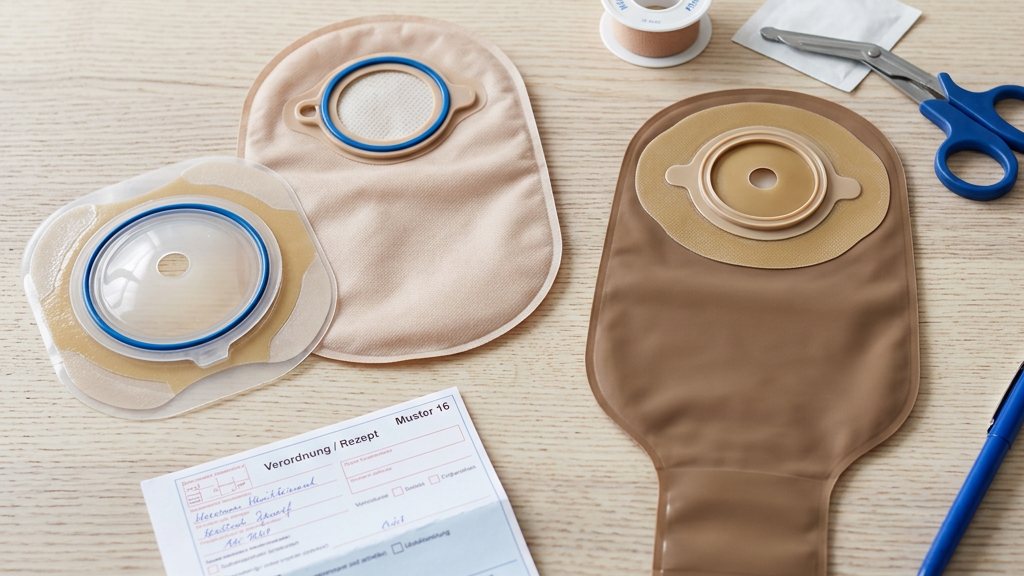
Whether the pouch and the skin protection form a single piece or consist of two parts helps determine how often your skin is put under strain when you change it and how the system sits in everyday life. Here you will find the differences and the points that matter when choosing.
Key points
- One-piece (einteilig): the pouch and the adhesive area are permanently joined – flexible and flat, but everything is removed from the skin at every change.
- Two-piece (zweiteilig): the baseplate (Basisplatte) stays on the skin for several days, and only the pouch is changed. This is gentler on the skin but bulkier.
- The German Society for Stoma, Continence and Wound Care (Fachgesellschaft Stoma, Kontinenz und Wunde, FgSKW) gives two to three days for baseplates with a urostomy or ileostomy and two to four days with a colostomy. What matters is how long the baseplate holds securely.
- Curved (convex) baseplates help with a retracted stoma, scars or skin folds. Only use them after professional advice.
- Which system suits you depends on the type of stoma, your skin, the shape of your abdomen, your everyday life and how well you can handle it. You can switch later.
What comes out of the stoma matters first
The type of stoma determines how much is excreted and how liquid it is:
- Colostomy (Kolostoma, an outlet from the large intestine): the stool comes in portions, is mushy to firm and is less harsh on the skin.
- Ileostomy (Ileostoma, an outlet from the small intestine): the stool is liquid, comes continuously and still contains a lot of digestive juices, which irritate the skin.
- Urostomy (Urostoma, an artificial urinary diversion): the urine drains constantly.
The pouch is chosen accordingly. According to Deutsche ILCO, the self-help association for people with a stoma, closed pouches are suitable if you have few, rather firm bowel movements and need no more than about three pouches a day. Drainable pouches (Ausstreifbeutel) are emptied into the toilet through an opening with a closure – suitable for frequent, soft to liquid output. Urostomy pouches have a non-return valve so that the urine does not flow back to the stoma. All three are available as one-piece and two-piece versions. How much is excreted also depends on your diet – see Eating and drinking with a stoma.
Why a pouch can balloon despite its filter, and what helps then, is explained in the article When an ostomy pouch inflates. How to connect a night bag to a urostomy is explained in the article Urostomy at night.
One-piece and two-piece compared
In a two-piece system, the pouch is attached to the baseplate either with a coupling ring that snaps on like a press stud or by means of an adhesive surface. The main differences:
| Feature | One-piece | Two-piece |
|---|---|---|
| Design | Pouch and adhesive area in one piece | Baseplate on the skin, the pouch is attached to it |
| Changing | The whole system is removed from the skin | The baseplate stays on for several days, the pouch is changed on its own |
| Strengths | very flexible, not bulky | gentle on the skin, especially if pouches have to be changed often |
| Weaknesses | Frequent removal puts strain on the skin and uses a lot of material | The coupling ring is bulkier and more likely to show under tight clothing; both types of coupling are less flexible |
How often to change
The FgSKW has published guide values which, it expressly states, are based on its experience (as of 2011). They apply to intact skin and a well-positioned stoma without complications:
| System | Urostomy | Ileostomy | Colostomy |
|---|---|---|---|
| one-piece | at least once a day | at least once a day | one to three times a day |
| two-piece: baseplate | every 2 to 3 days | every 2 to 3 days | every 2 to 4 days |
| two-piece: pouch | at least once a day | at least once a day | as needed, one to three times a day |
If the stoma lies in a fold, at skin level or below it, a shorter interval may be needed. If your individual wear time is exceeded, there is a risk of skin damage, because the skin protection breaks down from the stoma outwards. Changing too often, on the other hand, can irritate the skin mechanically – the society points this out for one-piece colostomy pouches.
Deutsche ILCO does not set a fixed time frame for the baseplate: it is changed as soon as it no longer adheres securely or begins to break down around the stoma – this can be after one day or only after a week. The health portal of the Institute for Quality and Efficiency in Health Care (IQWiG) gives three to five days. Your wear time depends on the amount and consistency of the output, on sweating and on your skin; it is best to determine it together with your stoma therapist (Stomatherapie). A tip from ILCO: change at a time of day when there is little output.
When a convex baseplate makes sense
Curved baseplates, also called convex baseplates, bulge towards the skin around the opening. Their pressure creates a seal where a flat baseplate cannot find a secure hold – according to the FgSKW, for example with a retracted stoma, a stoma at skin level or in folds and scars. For minor unevenness, according to ILCO, a flat baseplate and a little paste or mouldable skin protection are often enough.
Too much pressure can damage the tissue if worn for a long time. For products with a firm convexity, the society therefore advises critically checking whether they are needed, giving thorough advice and checking the skin regularly. Particular caution is needed, among other things, with a hernia next to the stoma, with diabetes, when taking cortisone or blood thinners and in the early period after the operation. If the shape of your abdomen changes, for example due to a parastomal hernia, the system should be reviewed and adjusted if necessary.
What guides the choice
The list of medical aids (Hilfsmittelverzeichnis) of the statutory health insurance funds (product group 29 “Ostomy articles”, Stomaartikel) requires suppliers to take into account, among other things, the position of the stoma, the skin, work, leisure activities, clothing habits and known allergies when making a choice. Ask yourself:
- Skin: Is it sensitive or irritated? Then there is a lot to be said for a baseplate that is removed less often.
- Abdomen: Folds, scars or a retracted stoma often call for a different baseplate than a smooth abdominal wall.
- Everyday life: Under tight clothing, a flat system is less noticeable.
- Handling: Can you manage closures and cutting the baseplate to size?
When you are first supplied and when you change products, you should be offered various suitable products to try out, preferably from different manufacturers. Your entitlement also includes instruction in their use (§ 33(1) SGB V, Social Code Book V). An overview is given on the page Ostomy.
Frequently asked questions
Can I switch to the other system later?
Yes. What suited you in hospital does not necessarily prove itself at home; sometimes only everyday life shows which system is the most suitable, ILCO writes. Get advice when you switch, so that the baseplate and its opening fit your stoma.
How big does the opening in the baseplate need to be?
It should surround the stoma without constricting it and leave no skin uncovered – this is particularly important with liquid output and with urine. The society provides for checking the size of the stoma at every change and adjusting the opening if necessary. How to go about this is shown in the article Measuring your stoma and cutting the baseplate; more on skin care can be found in Protecting the skin around the stoma.
Is changing more often more hygienic?
No. As long as the baseplate is intact, there is no reason, according to ILCO, to remove it earlier for “hygiene” reasons. Every removal puts strain on the skin. What matters is changing in good time as soon as the adhesion weakens or the system starts to leak.
Does the health insurance fund pay for both systems?
One-piece pouches, baseplates and the matching pouches are listed in the list of medical aids. With a doctor’s prescription, the health insurance fund (Krankenkasse) covers the necessary supply, apart from the statutory co-payment (Zuzahlung). The prescription states the name, quantity, period and the reason, for example colostomy. If you choose products that go beyond what is necessary, you pay the extra costs yourself (§ 33(1) SGB V) – see Paying extra for medical aids.
How PharmaCare helps
Our qualified specialists advise you independently of any manufacturer on one-piece and two-piece systems and on flat and convex baseplates – with products from all well-known manufacturers. Send us your original prescription (Rezept), the easiest way is with our free envelope (forms and free envelope (in German)); a photo via WhatsApp or Signal is enough in advance. We arrange approval with your health insurance fund and deliver discreetly to your home.
0800 74 222 73WhatsAppSignalSources
- Guideline on ostomy care (PDF), German Society for Stoma, Continence and Wound Care (Fachgesellschaft Stoma, Kontinenz und Wunde e. V.), updated August 2011 (in German)
- Recommendations on the use of convex products in ostomy care (PDF), German Society for Stoma, Continence and Wound Care, 3rd draft, 2013 (in German)
- Information on ostomy care, Deutsche ILCO e. V. (in German)
- What is an artificial bowel outlet (stoma)?, gesundheitsinformation.de (IQWiG), created on 4 March 2026 (in German)
- List of medical aids, product group 29 “Ostomy articles” (PDF), National Association of Statutory Health Insurance Funds, update of 1 April 2022 (in German)
- § 33 SGB V – Medical aids, Federal Ministry of Justice (in German)
Note: This article gives a general overview and does not replace medical or legal advice. Your health insurance fund or long-term care insurance decides on your entitlement. The text was written with the help of artificial intelligence; all information has been checked against the sources listed. As of: 24 September 2026.