
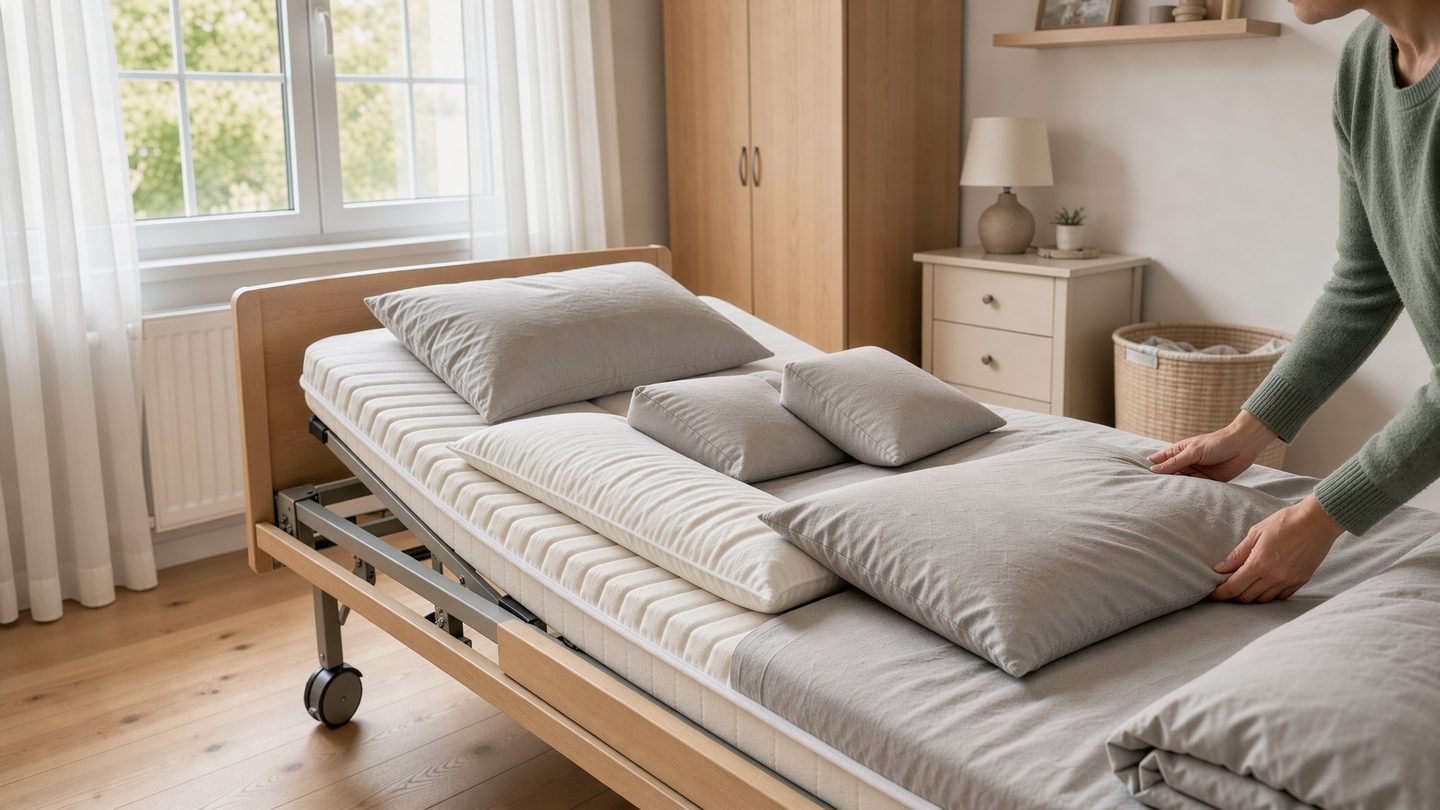
Anyone who spends a lot of time lying or sitting and can hardly move on their own has an increased risk of a pressure ulcer. At home, relatives can do a great deal to stop one developing in the first place. Here you can read what to look out for, how to relieve pressure and which aids the health insurance fund and the long-term care insurance cover.
Key points
- A pressure ulcer (Druckgeschwür or Dekubitus) is a wound caused by sustained pressure – almost always where a bone lies close beneath the skin, for example at the tailbone, heels or hips.
- The best protection is to change the lying or sitting position regularly and to move as much as possible. How often a change of position is needed varies from person to person.
- Look at the at-risk areas regularly. If redness remains even though there is no longer any pressure on it, relieve the pressure on the area immediately and show it to a registered nurse or a doctor.
- Pressure-relieving mattresses (Antidekubitus-Matratzen), overlays and seat cushions are medical aids (Hilfsmittel) from the health insurance fund (Krankenkasse) (product group 11 of the list of medical aids), usually with a doctor’s prescription. The long-term care insurance (Pflegekasse) does not pay for a pressure-relieving mattress.
- If you have a care level (Pflegegrad), you can get a care bed through the long-term care insurance. If the care assessment report (Pflegegutachten) recommends an aid against pressure ulcers, this counts as an application with your consent – a prescription is then not needed.
What is a pressure ulcer?
Specialists describe a pressure ulcer as localised damage to the skin and/or the underlying tissue. It is caused by pressure, alone or in combination with shear forces, typically over bony prominences. If body weight presses on the same spot for a long time, the skin there no longer receives enough blood and is no longer adequately supplied with oxygen and nutrients. It becomes thinner and can die.
When lying down, the areas most at risk are the tailbone, heels, hips, shoulder blades, ankles, elbows, ears and the back of the head; when sitting, it is above all the buttocks. With good treatment, smaller pressure ulcers often heal within a few weeks; deep wounds take considerably longer. Anyone who has had a pressure ulcer before is more likely to get another one in the same place. Prevention therefore pays off twice over.
Who is particularly at risk
Healthy people move constantly, even in their sleep, and quickly notice when an area has been under strain for too long. People who can no longer do this or no longer notice it have an increased risk:
- very frail, seriously ill or bedridden people and anyone who spends a lot of time sitting in a wheelchair
- people with paralysis who feel neither pressure nor pain in the affected parts of the body
- people who have had diabetes for years, because their sensitivity to pain can decline
- people with circulatory disorders, for example due to narrowed blood vessels
- people who eat and drink little or are underweight
- people with incontinence whose skin stays damp for long periods and therefore becomes sore more easily
Friction and shear forces cause additional damage, for example when someone is dragged across the sheet while being repositioned. This makes the layers of skin shift against each other.
Watching the skin: how to spot the first signs
Anyone who can still turn over on their own checks the at-risk areas with a mirror. If someone cannot turn over, sit up or stand up on their own, they need help with this – especially as most at-risk areas are on the back of the body, for example the buttocks and shoulder blades. Also take it seriously if the person concerned says that an area feels sore.
A pressure ulcer can start before the skin breaks. Registered nurses and doctors usually assess its severity in four stages:
| Stage | What you see |
|---|---|
| 1 | Skin intact; light skin stays red even when there is no longer any pressure on it, dark skin changes colour. The area may be warmer or cooler, softer or firmer and more sensitive than the surrounding skin. |
| 2 | The upper layers of skin are damaged, for example by a blister, a graze or a bruise. |
| 3 | All layers of skin are destroyed, and the wound can reach into the fatty tissue; coatings (slough) or dead tissue are possible. |
| 4 | Skin and deeper tissue are destroyed; muscles, tendons or bones are exposed. |
If a wound is covered with a scab or a coating, its depth cannot be seen straight away. Sometimes the skin is also intact and reddish-brown in colour, even though the tissue underneath is already damaged. Redness caused by urine or stool looks similar but has a different cause and needs different care; how to tell the two apart is explained in the article Sore skin with incontinence.
Relieving pressure: movement and changes of position
The most important thing is to keep relieving the at-risk areas of pressure. This already applies if someone only has to lie in bed for a few days or has to sit a lot.
- Encourage movement: Anyone who can get up, sit up or walk a few steps with a little support should ideally do so as often as possible. Help only as much as necessary – what the person can manage themselves, they should also do themselves.
- Change position: Pay attention to which areas bear the most pressure in which position, and change the lying or sitting position regularly.
- Do not drag: Do not pull the person across the surface when repositioning them. This avoids friction and shear forces.
- Sitting: When sitting, there is more pressure on the buttocks than when lying down. A soft, pressure-distributing surface such as a seat cushion can help. Wheelchair users can learn to relieve the pressure themselves at regular intervals.
- Keep the heels free: In bedridden people, the heels often rest on the mattress for hours. A cushion under the leg raises them; heel protectors can also reduce the pressure. However, getting up and walking around in heel protectors can increase the risk of falling.
It is often said that a person should be repositioned every two hours. However, studies have not been able to establish which interval is best. Some people tolerate longer breaks, others need very frequent changes of position. Repositioning too often has disadvantages: it disturbs sleep, can be painful and is also a strain on the carers. So observe what is really necessary and write down the changes of position. If a home care service (Pflegedienst) looks after the person, it is best to agree this together in the care plan.
Skin care and moisture
The skin should be clean and should neither dry out nor stay damp all the time – both make it more vulnerable. Creams and lotions are useful if the skin is very dry; they should suit the skin type and be applied gently. However, there is no evidence that regularly applying cream prevents pressure ulcers. Do not rub at-risk skin vigorously, as this can damage it further.
With incontinence, it is important to change pads or incontinence pants in good time so that urine and stool do not stay on the skin for long. How to clean and protect the skin properly is explained in the article Sore skin with incontinence. If the risk is high, for example if someone lies down a great deal, a wound dressing can also be stuck on a particularly at-risk area such as the tailbone as a preventive measure; it protects the skin from friction. Whether this makes sense is something to clarify with a registered nurse.
Eating and drinking
Some people who can hardly move any more have little appetite or thirst. However, too little fluid and undernutrition or malnutrition weaken the skin further. So make sure the person drinks enough and has balanced meals. For malnutrition, there are high-calorie, high-protein oral nutritional supplements (Trinknahrung) in addition to meals; talk to the doctor about this. According to the studies so far, it is unclear whether such supplements prevent pressure ulcers – they can still be important for the person’s general condition. How to store oral nutritional supplements correctly and what helps if you grow tired of the taste over time is explained in the article Oral nutritional supplements in everyday life.
What aids against pressure ulcers are available
Pressure-relieving mattresses and overlays can reduce the risk of a pressure ulcer. However, they do not replace movement and changes of position. In the list of medical aids (Hilfsmittelverzeichnis) of the National Association of Statutory Health Insurance Funds (GKV-Spitzenverband), they are listed in product group 11 “Aids against pressure ulcers” (Hilfsmittel gegen Dekubitus):
- Overlays (Auflagen) are placed on top of the existing mattress; pressure-relieving mattresses replace it.
- Soft positioning (Weichlagerung): foam, gel or air chambers spread the body weight over a larger area and so relieve individual spots.
- Alternating pressure (Wechseldruck): a device inflates and deflates air chambers in turn, so that different areas are relieved alternately. Such systems are mostly used by people at particularly high risk.
- Seat cushions made of foam or gel or with air cells, for a wheelchair or chair.
- Positioning aids (Positionierungshilfen): specially shaped cushions and pads for the arms, legs, trunk or the whole body, as well as heel and joint protectors.
There is no fixed rule about which product suits which level of risk; it is chosen according to the person’s abilities and their care situation. Under the requirements of the list of medical aids, the supplier advises you personally and, as a rule, instructs you in its use at your home. Ordinary cushions count as everyday commodities (Gebrauchsgegenstände des täglichen Lebens) and are not paid for. The National Association of Statutory Health Insurance Funds does not include seat and positioning rings in the product group, because there is no evidence that they help against pressure ulcers.
Who pays for what?
The health insurance fund is responsible for aids against pressure ulcers (§ 33 SGB V): they serve to prevent a pressure ulcer and to support its treatment. In most cases you need a doctor’s prescription for them, which you take to a supplier that has a contract with your health insurance fund. The health insurance fund can also provide medical aids on loan.
The long-term care insurance pays for care aids (Pflegehilfsmittel) that make care at home easier (§ 40 SGB XI). These include care beds with accessories and positioning aids that help with changing position in the care bed (product group 50 of the list of care aids, Pflegehilfsmittelverzeichnis). The prerequisite is a care level. The long-term care insurance is supposed to provide technical care aids primarily on loan. A care bed also includes a mattress if the existing one is not suitable – but according to the list of care aids, the long-term care insurance expressly does not pay for a mattress for preventing pressure ulcers. It currently pays up to 42 euros a month for consumable care aids such as disposable gloves or disposable bed protectors (§ 40(2) SGB XI). The draft bill for the Care Reorganisation Act (Pflegeneuordnungsgesetz, printed paper 21/8869) provides that this separate entitlement would end on 1 January 2027; in its opinion of 20 November 2026, the Bundesrat asks for an examination of how it can in principle be retained as an earmarked benefit in kind (Sachleistung) (printed paper 587/26 (Beschluss), item 17). Nothing has been decided yet – until the law is changed, the 42-euro rule applies; more in the article on the care aids package.
| Aid | Who pays | What you need |
|---|---|---|
| Pressure-relieving mattress or overlay | Health insurance fund, § 33 SGB V (product group 11) | usually a doctor’s prescription; alternatively a recommendation in the care assessment report |
| Pressure-relieving seat cushion, positioning aids, heel protectors | Health insurance fund, § 33 SGB V (product group 11) | usually a doctor’s prescription; alternatively a recommendation in the care assessment report or by a registered nurse |
| Care bed with accessories | Long-term care insurance, § 40 SGB XI (product group 50) | care level and application; also a recommendation in the care assessment report or by a registered nurse |
Care beds can serve both medical treatment and care. For such aids, the fund to which you submit the application checks who is responsible and decides (§ 40(5) SGB XI); the co-payment (Zuzahlung) then follows the rules of health insurance. How high the co-payment for medical aids is and what changes on 1 January 2027 is explained in the article Co-payment 2027. The article Health insurance fund or long-term care insurance gives an overview of the tasks of both funds.
A recommendation instead of a prescription: care assessment and registered nurse
In the care assessment report
During the assessment for a care level, the assessor makes specific recommendations on medical aids and care aids. If you agree, they count as an application (§ 18b(3) SGB XI). According to the assessment guidelines (Begutachtungs-Richtlinien) of the Medical Service (Medizinischer Dienst), aids against pressure ulcers can also be recommended. Recommended aids are presumed to be necessary; a doctor’s prescription is then not needed. How the assessment works is described in the article Applying for a care level.
By a registered nurse
Registered nurses (Pflegefachpersonen) may also recommend medical aids and care aids (§ 40(6) SGB XI) – if they come to you as a home care service, as part of home nursing care (häusliche Krankenpflege), as part of out-of-hospital intensive care (außerklinische Intensivpflege) or for a counselling visit under § 37(3) SGB XI. The recommendation may be no more than two weeks old when the application is made, and it replaces the prescription. Which products this covers is laid down in directives of the National Association of Statutory Health Insurance Funds that have applied since 1 September 2026. From product group 11, they list pressure-relieving seat cushions and positioning aids, as well as care beds with accessories. Pressure-relieving mattresses and overlays are not included; for these, a doctor’s prescription or a recommendation in the care assessment report is still required. More on this in the article Medical aids without a doctor’s prescription.
When you need medical or nursing help
If you notice a red or sore area, relieve it of pressure immediately and show it promptly to the GP practice or a registered nurse. This applies in particular if
- redness remains even though the area is no longer under strain,
- the area feels warmer, cooler, firmer or softer than the surrounding skin, or hurts,
- a blister, a graze or an open area has developed, or
- a wound has coatings or a scab.
An open wound is a point of entry for pathogens. It can become inflamed, and if the pathogens spread, there is a risk of blood poisoning (sepsis). That is why every open area belongs in professional hands. A pressure ulcer is treated above all by consistently relieving the pressure on the area and dressing the wound with wound dressings that cover it, keep it moist and protect it from infection. Which wound dressings the health insurance fund will cover from 2027 is explained in the article Wound dressings from 2027. When a dressing is changed and what hygiene applies is explained under Changing dressings on chronic wounds.
What home care services follow: the expert standard
For nurses in hospitals, care homes and home care services, the expert standard (Expertenstandard) “Pressure ulcer prevention in nursing” (Dekubitusprophylaxe in der Pflege) of the German Network for Quality Development in Nursing (DNQP), last updated in 2017, applies. Under this standard, the nurse assesses the risk at the start of care, plans the measures together with the person concerned and their relatives, explains them and trains them, encourages the person’s own movement and ensures that suitable pressure-distributing aids are used if movement alone is not enough. The nurse examines the skin at intervals that she or he sets for each person. The standard expressly involves relatives and stresses that aids support but do not replace encouraging the person’s own movement.
Since 2026, the DNQP has been working on the third update. The new version is due to be published in 2027.
Frequently asked questions
Do I have to reposition the person every two hours?
Not necessarily. The two-hour rhythm is a widespread rule of thumb, but it is not supported by studies. How often someone needs to be repositioned depends on the person. Watch the skin, write down the changes of position and agree the rhythm with the home care service or the GP practice.
Does a seat ring or a sheepskin help?
According to the National Association of Statutory Health Insurance Funds, there is no evidence that seat and positioning rings help against pressure ulcers; they are therefore not included in the list of medical aids. Special sheepskins do provide padding, but the skin can become very warm with prolonged contact, and they are laborious to clean. Specialists usually recommend pressure-relieving mattresses and foam cushions.
Does the long-term care insurance pay for a pressure-relieving mattress for the care bed?
No. A care bed includes a normal mattress if the existing one cannot be used. A mattress for preventing pressure ulcers does not fall within the benefits of the long-term care insurance; it is a medical aid from the health insurance fund in product group 11.
Can the home care service recommend a pressure-relieving mattress?
Under the directives of the National Association of Statutory Health Insurance Funds, a recommendation that replaces the prescription is possible for pressure-relieving seat cushions and positioning aids, but not for mattresses and overlays. For a mattress, you need a doctor’s prescription – or a recommendation in the care assessment report.
Where can relatives learn how to position someone correctly?
In care courses (Pflegekurse) run by the long-term care insurance funds. They are free of charge for relatives and, on request, can also take place at your home (§ 45 SGB XI). Many towns and cities also have care advice centres (Pflegeberatungsstellen) that help with questions about prevention. The supplier who delivers a medical aid instructs you in its use.
How PharmaCare helps
If, despite every precaution, a wound develops, we deliver the wound dressings and dressing materials prescribed by your doctor discreetly to your home and invoice your health insurance fund directly – more under wound care (in German). For incontinence, we supply you with absorbent incontinence aids on prescription, independently of any manufacturer; our product search (in German) contains around 4,000 items.
If you have a care level, you can get monthly packages of consumable care aids from us, such as disposable gloves and bed protectors; the long-term care insurance currently pays up to 42 euros a month (on the planned reform, see Future Pact for Care). You will find the application forms among our downloads (in German). Our qualified specialists advise you free of charge, Monday to Friday from 8 am to 5 pm, also via WhatsApp and Signal.
0800 74 222 73WhatsAppSignalSources
- Pressure ulcers (decubitus) and Preventing pressure ulcers, Institute for Quality and Efficiency in Health Care (IQWiG), gesundheitsinformation.de, updated 18 February 2026 (in German)
- Pressure ulcers (decubitus), gesund.bund.de, Federal Ministry of Health in cooperation with IQWiG, as of 23 January 2023 (in German)
- Expert standard “Pressure ulcer prevention in nursing”, second update 2017 (extract), German Network for Quality Development in Nursing, as of April 2017; press release on the third update, 11 February 2026 (in German)
- Product group 11 “Aids against pressure ulcers” (update of 19 February 2024) and Product group 50 “Care aids to make care easier” (update of 3 December 2024), National Association of Statutory Health Insurance Funds (in German)
- Directives on the recommendation of medical aids and care aids by registered nurses, National Association of Statutory Health Insurance Funds, 6 July 2026, in force since 1 September 2026; Directives defining dual-function aids, National Association of Statutory Health Insurance Funds, version of 24 June 2020 (in German)
- Assessment guidelines for determining the need for long-term care, Medical Service at federal level (Medizinischer Dienst Bund), in force since 1 October 2026 (in German)
- § 33 SGB V – Medical aids; SGB XI: § 18b – Content of the assessment report, § 40 – Care aids, § 45 – Care courses for relatives, Federal Ministry of Justice (in German)
- Printed paper 21/8869, government draft bill on the Care Reorganisation Act, German Bundestag (in German)
- Opinion of the Bundesrat on the draft Care Reorganisation Act, printed paper 587/26 (Beschluss) of 20 November 2026, Bundesrat (in German) – item 17
Note: This article gives a general overview and does not replace medical or nursing advice. The treatment of a pressure ulcer belongs in the hands of doctors and nurses. Your health insurance fund or long-term care insurance decides on your entitlement. The text was written with the help of artificial intelligence; all information has been checked against the sources listed. As of: 21 November 2026.