
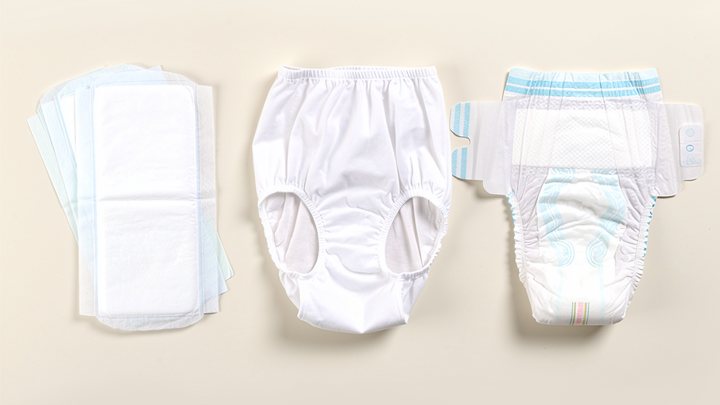
A pad worn in fixation pants, pull-up pants or an all-in-one brief with tabs: absorbent incontinence aids come in many variants. Here you can find out how they differ and what the choice is based on.
Key points
- Pads (Vorlagen) are worn in fixation pants (Fixierhose), also called mesh pants (Netzhose). All-in-one briefs (Windelhosen, often called Slips) are closed with adhesive or grip tabs; pull-up pants (Pants) are put on like underwear.
- The list of medical aids (Hilfsmittelverzeichnis) of the health insurance funds (Krankenkassen) classifies products by tested absorbency: pads in four levels from 150 millilitres, all-in-one briefs and pants in three levels from 500 millilitres.
- Drops on the packaging are a manufacturer’s specification; the list of medical aids does not use them.
- Which product suits you depends on how much urine is lost in what time, on day and night, on your mobility and on who puts the product on.
- You are entitled to a supply without extra costs; for this, the supplier must offer you a sufficient choice of suitable products.
The types of product at a glance
Absorbent incontinence aids are listed in product group 15 “Incontinence aids” of the list of medical aids published by the National Association of Statutory Health Insurance Funds (GKV-Spitzenverband). They are built up in layers: a core of pulp and superabsorbent binds the urine, a soft fleece protects the skin from rewetting, and a leakproof outer layer prevents wetness from coming through.
| Type of product | How it is worn | Minimum absorbency according to the list of medical aids |
|---|---|---|
| Anatomically shaped pad | in fixation pants; it can also be secured, for example with adhesive strips on the underside | low 150 millilitres (for urinary incontinence only), normal 450, increased 600, high 900 millilitres |
| Fixation pants (mesh pants) | elastic, breathable mesh fabric holds the pad against the body; usually washable, also available for single use; size 1 or 2 | do not absorb anything themselves |
| All-in-one brief (Windelhose, Slip) | is placed around the body and closed with resealable adhesive or grip tabs | normal 500, increased 750, high 1,000 millilitres |
| Pull-up pants (Pants, incontinence underwear) | closed all round with an elastic waistband, put on and taken off like underwear; can be torn open at the sides but not closed again | as for all-in-one briefs |
All-in-one briefs and pants come in three sizes based on hip circumference: up to 80 centimetres, up to 110 centimetres and 110 centimetres or more.
What changed in 2025
The National Association of Statutory Health Insurance Funds revised the product group and published the update on 30 January 2025. A new level has been added for pads with low absorbency, intended for small amounts of urine. Rectangular pads and washable absorbent incontinence pants are no longer included, because no products were listed there any more. The pants that hold the pads in place are now called fixation pants.
Millilitres, not drops
Anyone who wants a product included in the list of medical aids must prove its absorbency using specified methods. In the laboratory, it is measured how much liquid the material absorbs in total, how quickly it absorbs and how much wetness comes back to the surface. In addition, an independent institute uses a test torso – a model of the body – to test how much a product takes up before it leaks.
The drops that some manufacturers use on the packaging to indicate absorbency are not part of this classification. What can be compared across brands is the absorbency level to which a product is assigned in the list of medical aids.
More absorbency is not automatically better. The list of medical aids makes clear that the number of products needed cannot be calculated from the amount of urine and the maximum absorption capacity alone: hygiene and the care situation also count, and depending on the case, five or more products may be needed in 24 hours. The aim is that the skin does not stay permanently damp.
What matters when choosing
The clinical guideline on advice on medical aids for urinary incontinence and the list of medical aids name points that should be taken into account in the choice:
- Amount and speed: Is a small amount of urine lost constantly, or a large amount in a short time? Each calls for different products, even if the daily amount is the same. Which pads are suitable for men with after-dribbling is explained in the article Dribbling after urinating.
- Day and night: If the loss differs over the course of the day, different products may suit you for day and night.
- Type of incontinence: With stress incontinence, the loss depends on movement; with urge incontinence, there is often a sudden gush – more in the article on types of urinary incontinence.
- Mobility: The guideline suggests categories ranging from bedridden, dependent on a wheelchair and mobile with a walking aid to fully mobile, working or active in sport.
- Handling: Do you put the product on yourself, or does someone help you? These abilities and the support available must be taken into account, as must body measurements and allergies.
On pants, the list of medical aids states that they offer no medical advantage over all-in-one briefs with tabs. They can, however, be the suitable and necessary supply – for example for people with physical or cognitive impairments who cannot be adequately supplied with a pad and mesh pants and who repeatedly take off a brief with tabs.
Your entitlement: advice, trying out, no extra costs
The requirements for suppliers are also set out in the list of medical aids. Among other things:
- You are informed about your entitlement to a supply without extra costs and are offered a sufficient choice of suitable products without extra costs.
- Your requirement is determined for you personally; flat-rate quantities are not suitable for this.
- When you are first supplied and when you change products, you receive various suitable products to try, if possible from different manufacturers.
- Deliveries come in neutral packaging; the quantity and frequency of deliveries are agreed with you.
If you choose a product that goes beyond what is necessary, you pay the extra costs (Mehrkosten) yourself (§ 33(1) SGB V) – more on this in the article on paying extra for medical aids. In addition, from the age of 18 you pay the statutory co-payment (Zuzahlung) of 10 per cent; for consumable products it is capped at a maximum amount for the monthly requirement. What currently applies is explained in the article on co-payments in 2027.
Supplying is not treating
Medical aids catch urine, but they do nothing about the cause – the guideline attaches importance to this. Everyone affected should be told about treatments, depending on the prospects of success, such as pelvic floor or bladder training, medication or an operation. According to the list of medical aids, the doctor should also check at regular intervals whether the supply is still needed.
Frequently asked questions
Do I always need fixation pants with pads?
The list of medical aids provides for pads to be worn in fixation pants; they hold the pad close to the body. In addition, it must be possible to secure pads, for example with adhesive strips. Fixation pants are medical aids in their own right and can be prescribed as well.
Can I use different products during the day and at night?
Yes. The guideline expressly names the pattern over day and night as a criterion for the choice. Which combination suits you is best found out by trying. More on supplies for the night and an evening routine in the article on incontinence at night.
How often should I change?
There is no fixed number. It depends on the amount, the product, hygiene and the care situation; depending on the case, five or more products a day may be needed. You should have changes to your skin checked by a doctor. How choosing the right product and changing it in good time help to avoid urine odour is explained in the article on urine odour with incontinence.
Does the health insurance fund also pay for pants?
Pants are included in the list of medical aids and can be prescribed. Because, according to the list, they offer no medical advantage over all-in-one briefs, whether they are the necessary supply depends on the individual case. Ask to be shown the options without extra costs as well.
Are bed protectors included?
Not among the incontinence aids in product group 15. Because they do not act directly on the body, the list of medical aids assigns bed protectors (Bettschutzeinlagen) to product group 19 “Nursing care articles”.
How PharmaCare helps
In our product search you will find around 4,000 items, including pads, pants, all-in-one briefs and fixation pants from all well-known manufacturers – for example the product lines MoliCare by Hartmann (in German) or TENA Pants (in German). We advise you independently of any manufacturer on the type of product, absorbency level and size, arrange approval with your health insurance fund on the basis of your prescription and deliver discreetly to your home.
You can reach our qualified specialists free of charge, Monday to Friday from 8 am to 5 pm, also via WhatsApp or Signal.
0800 74 222 73WhatsAppSignalSources
- List of medical aids, product group 15 “Incontinence aids”, National Association of Statutory Health Insurance Funds, published on 30 January 2025 (in German)
- Documents on the update of product group 15, National Association of Statutory Health Insurance Funds, 2025 (in German)
- Updates of the product groups, National Association of Statutory Health Insurance Funds (in German)
- S2k guideline “Advice on medical aids for urinary incontinence”, AWMF register 043-054, version 2.0 (2025), German Society of Urology (in German)
- § 33 SGB V – Medical aids, Federal Ministry of Justice (in German)
Note: This article gives a general overview and does not replace medical advice or legal advice. Your health insurance fund or long-term care insurance decides on your entitlement. The text was written with the help of artificial intelligence; all information has been checked against the sources listed. As of: 24 September 2026.